
Hi! I’m Hal. Thank you for your patience. I’ve been moving pretty slow lately. I know it’s been a while since I’ve posted. I’m glad you’re here. Please tap the PLAY button above to hear the intended PODCAST version of this episode. Find the full transcription below. Enjoy.
Color Theory (Part One)
I’ve recently discovered color theory and I’m hooked. Have you heard about it? Complementary, monochromatic, analogous, split complementary, triadic, hue, value, tint, shade, tone — all the things of the color wheel. It’s called “color theory” and I love it.
I’ve always been drawn to the theory of things. I remember coming home after graduating from Northwestern as a history major and realizing that I wanted to be a musician. I figured maybe the right thing to do would be to go back to Kent State as a post-undergrad and get a degree in music education. So, in order to prepare for the music major, I bought this programmed textbook called “Scales, Intervals, Keys, Triads, Rhythm and Meter” and I ate it up — the theory behind music. Finally, after years of piano lessons, I learned all the key signatures and I learned how to analyze a piece of music. It was like coming home to a language that was mine but I’d never known before.
Due to the onset of ME/CFS in 1991, I didn’t finish that music education degree. But for the next two years, I was signed up for that 8 am music theory class with Dr. DeVore. Until I got sick, I used to ride my bike over to Kent State every morning from my mom’s house. I loved it.
In high school, I had three years with the best grammar teacher in Ohio, Mr. Pollock. I learned how to pull apart a sentence. Mr. Pollock taught us a system for writing an essay — the introduction, the three body paragraphs and the conclusion.
Well, if you know me, you’ll know that I love anything with a system. I love to follow directions. Give me some directions to follow and I’ll follow them. Even though I always thought I was a hippie and the rules didn’t really apply to me, I learned later in life that I love a system. Give me a structure and I’ll thrive inside of it.
I’m drawn to things that have a system. I love to learn the theory of things. And I guess that’s the shit part about ME/CFS. There is no system. There’s no theory. It’s just a brutal illness with a mind of its own doing what it wants to do. Like my girlfriend Emma says, living with ME/CFS is like walking a tightrope and you’ve got a blindfold on and the tightrope is constantly moving and you have no idea how far of a drop it is to the floor.
2026 has started off rough for me with this illness. After a handful of months of significantly milder symptoms in 2025, since the beginning of the year, you might say I’ve fallen off the tightrope a few times. The falls have come in the form of these things we call “crashes” — catastrophic, sudden onsets of intense illness. They come out of the blue and then they last for days or weeks or months… possibly a lifetime.
That’s the thing. You never know. With ME/CFS, there is no theory. There’s no system. I guess like everybody else in this world, we live in the unknown. We’ve got a monster in our beds and we really never know when it’s gonna strike next.
For me, it struck hard this year. It’s been brutal. I’m mostly bed bound these days. I went from being mostly house bound to definitely house bound to mostly bed bound. For the second time, I had to cancel a trip to England, I’ve had to let go of most of the things I enjoy and I’ve had to spend many hours writhing in a bed. I got the numb-fuck in the brain, I got the deep weakness in the hands and the legs and I got that awful burning weakness in the core, always on the verge of a crash.
It means I’ve got to spend most of my time in quiet time — legs up, head back, looking for some good in the murky chaos of my inner world. Fortunately, I appreciate quiet time and I know there’s great benefit in the stillness and the quiet and the solitude. I’m spending most of every day alone, in the dark, with an eye mask on.
Truly, it’s remarkable what I’ve adapted to over the last four or five years. I mean, you should have seen me back in 2019 and 2020. I went non-stop. (lol) I never stopped. I ran constantly — constantly in the car, loading up, heading off somewhere, always making urgent plans trying to figure out how to keep building the Hal Walker Enterprise.
In many ways, I’ve let go of that enterprise. A very important person in my life has encouraged me to “practice being insignificant — one among many.” That speaks to me. For a guy like me, that’s a big deal. But I believe in it. I’m giving it a try. I appreciate being able to tell my story here on Substack. Thanks so much for being here.
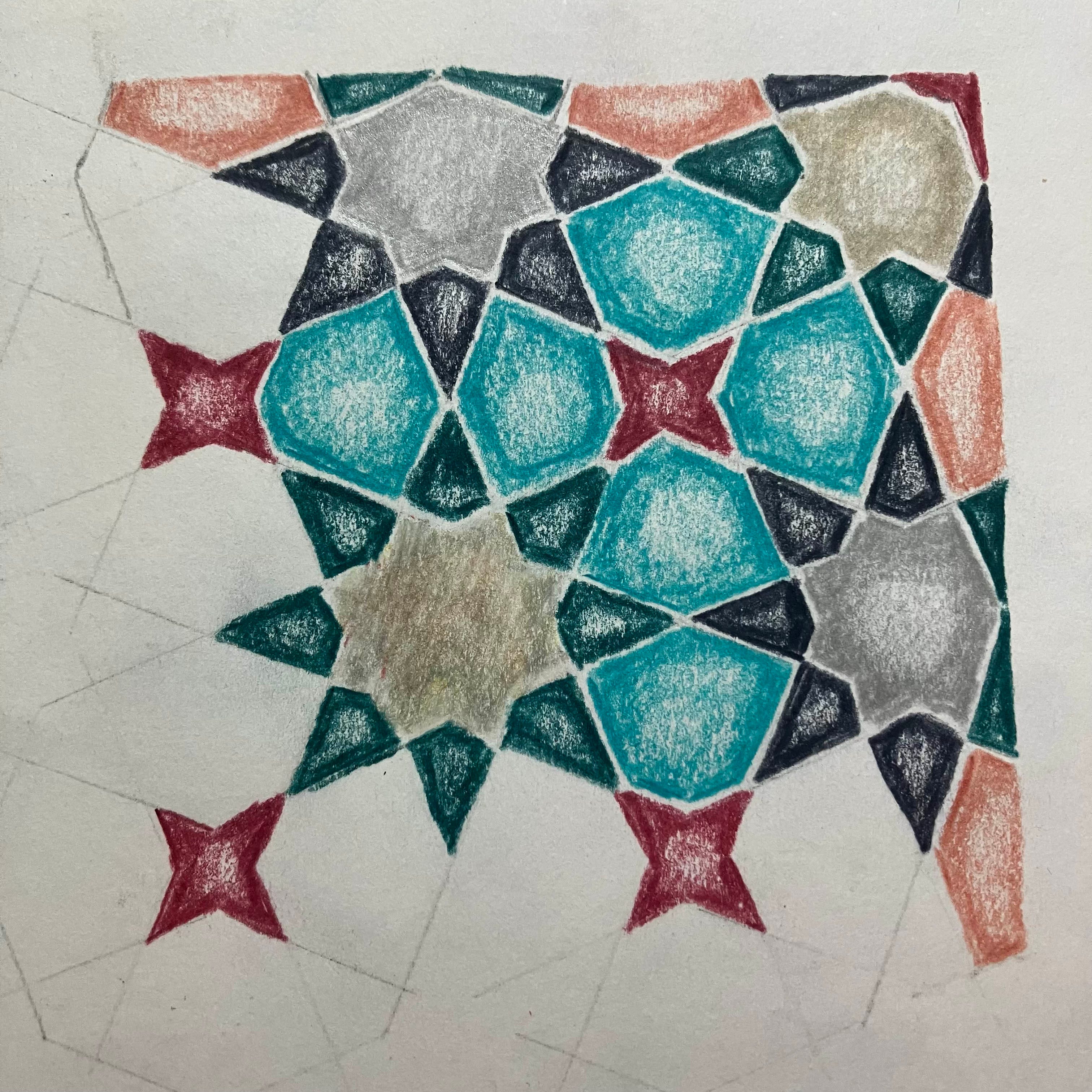
During my better months last year, I set up my dining room table to be an art table. It’s still covered with art supplies today while I lay here in bed. But, as you may have learned in my last episode, I’ve become very interested in Islamic geometric patterns. This kind of art touches my brain in such a beautiful way. Back in 10th grade, I loved geometry… and then I forgot about it for about 40 or 50 years. But I love me some geometry. I love shapes. I love angles. I love circles. And I love tessellating patterns.
So I signed up for a couple online classes at the Global Islamic Art Academy led by Mohammed Al Janabi, who teaches a very systematic way of drawing these traditional patterns. He’s been doing it for about 70 years, I think. He learned it from his father. I’m learning to follow very precise instructions to create circles and stars and rosettes and kite shapes — coming together to form these gorgeous, intricate, traditional, repeating Islamic patterns.
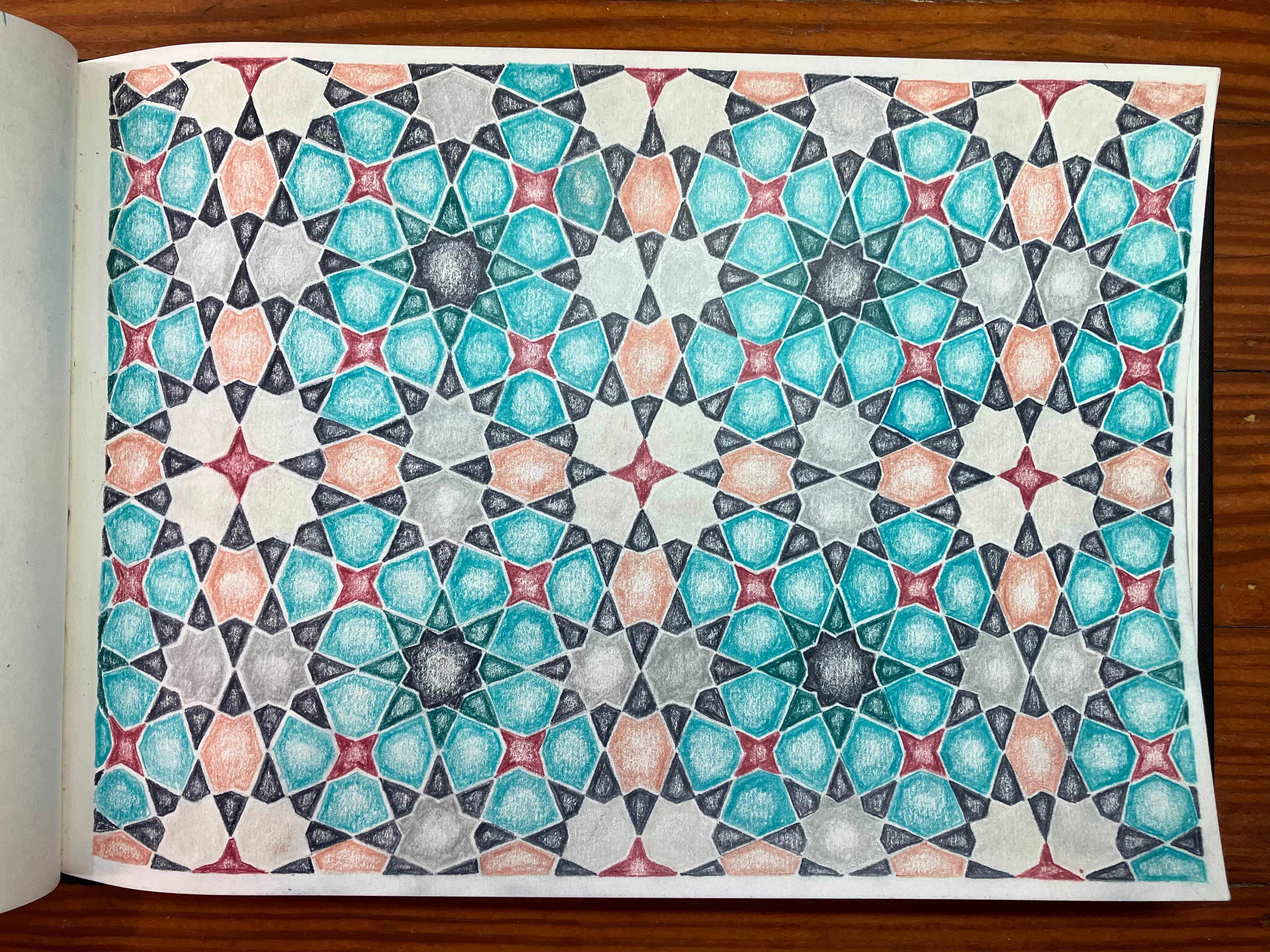
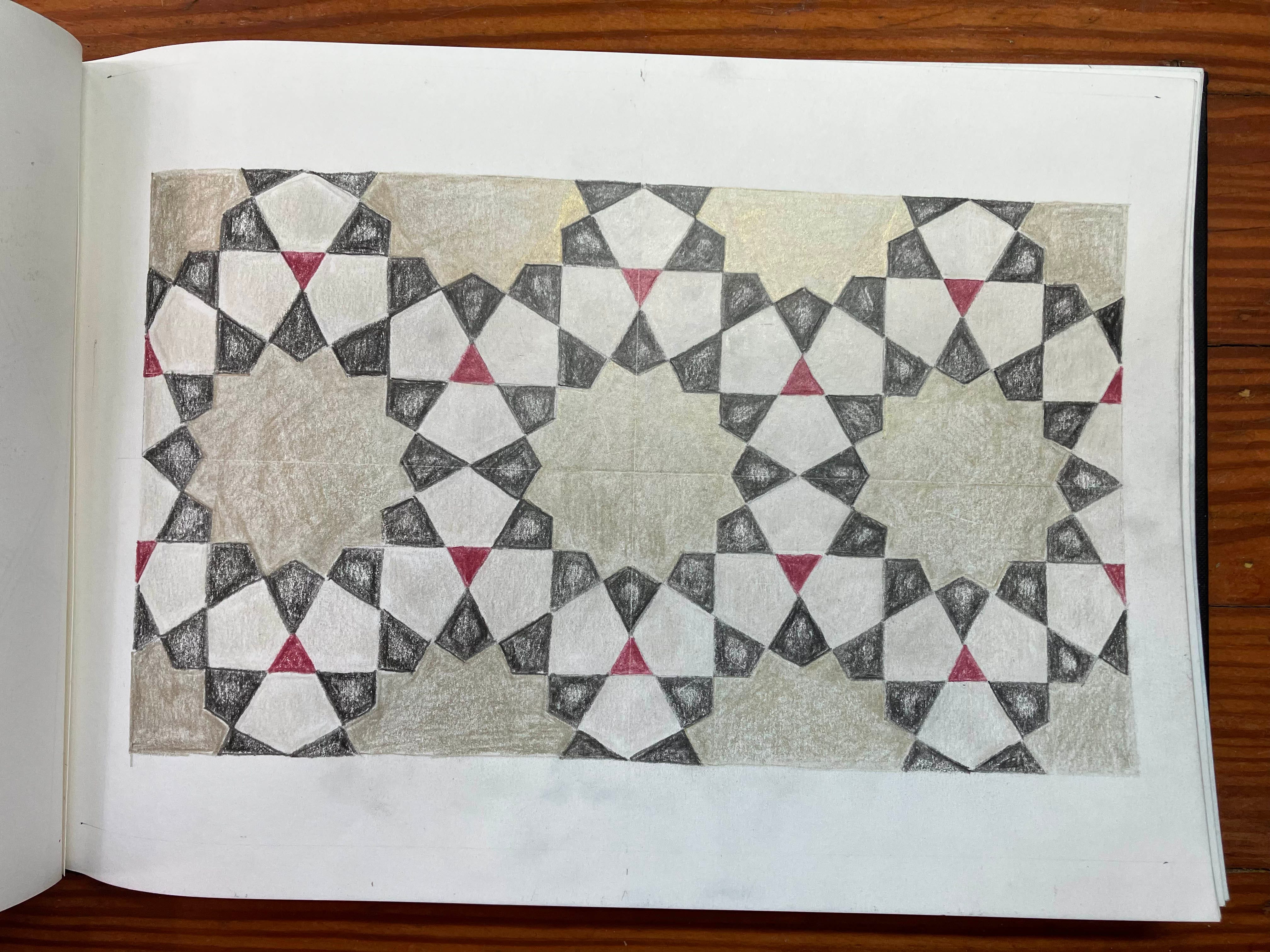
So I was creating these patterns and filling the shapes with something called stippling — thousands and thousands of tiny dots. I was quite satisfied with the glassy panes of various shades of gray. Gray was enough for me. You know, I’ve never been a big color guy. When people ask me my favorite color, I say “shades of brown.” My wardrobe always tended toward brown and gray and maroon, all the neutral tones. All the walls in my house are shades of beige and brown… and yellowish. So when I’d show these patterns to Emma, with all the stippling, she’d say, “Hal those patterns are screaming for color. They’re dying for color. Put some color in there.” Her walls are turquoise and purple and pink.
In my explorations of Islamic art, I’ve found Instagram to be an amazing place for meeting wonderful artists doing beautiful work. One day, I was scrolling on the Islamic geometric art feed and I came across a single photo by an artist named Charlotte Dilly. It’s interesting to me how this humble photo jumped out at me as being something important. This was a technique that I needed to learn.
This artist had colored a pattern with colored pencil using a very beautiful gradient technique that I had never even imagined before. I mean, for me, colored pencils were just something to scribble with. I never imagined the beauty that they could create until I saw that photo. I was immediately drawn to it. I was like, “Oh my gosh, I didn’t know you could do that with colored pencils. I’ve never seen that kind of depth. I’ve never seen that kind of warmth. and subtlety.”
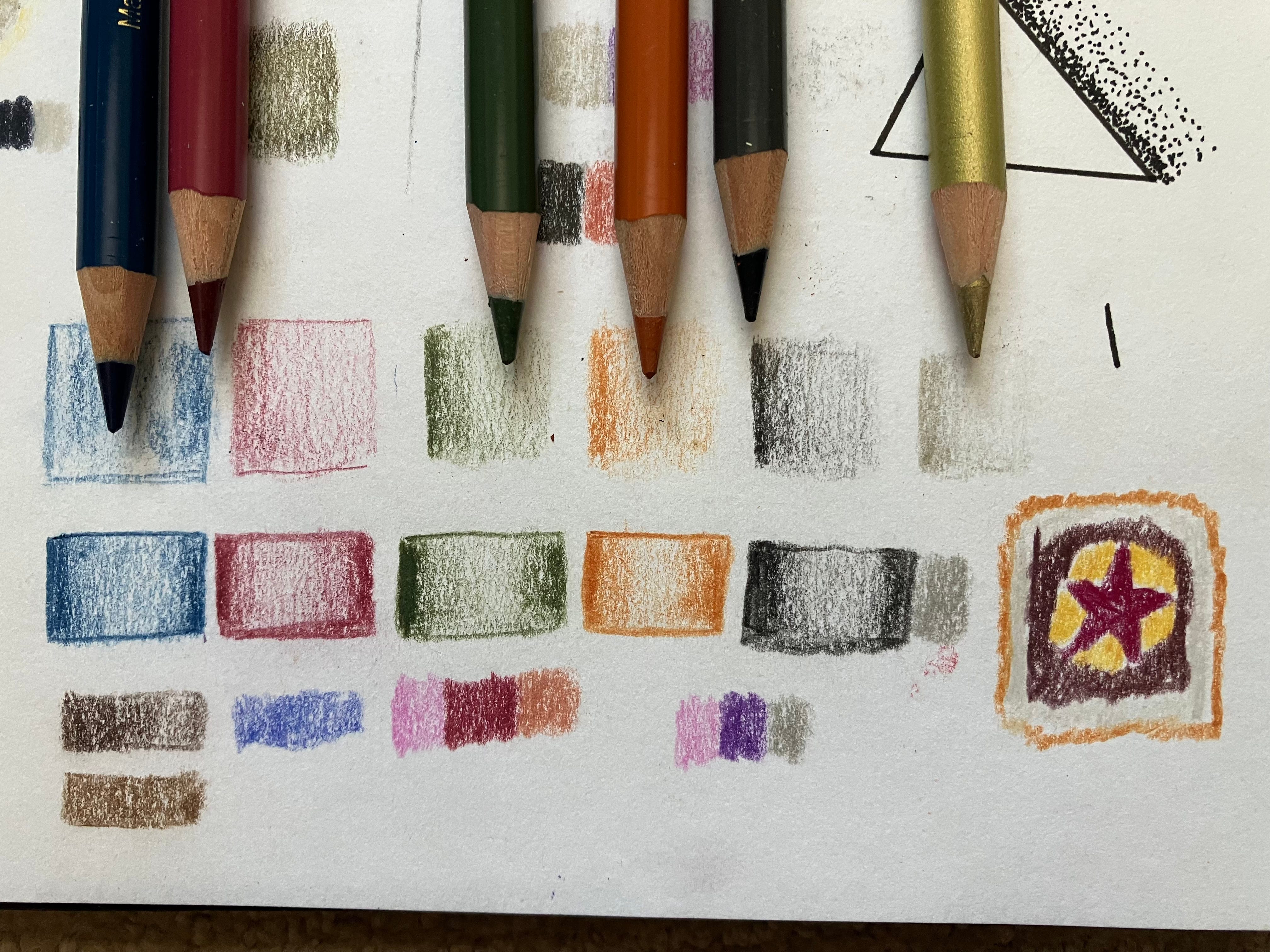
So I went to my direct messages, and I messaged Charlotte Dilley. I said, “What are those pencils? I need to know?” And she said, “they’re Faber Castell Polychromos pencils.” I learned that Polychromos pencils are an oil based pencil. They’re nice, but they’re not super special or anything. I mean they’re just colored pencils, but “Wow,” I thought. “I need to get me some of those.”
So I loaded my wheelchair up onto the rack in the back of my car and I drove over to the All Media store on the other side of Kent. All Media is an art store that’s been there for like, 50 years. It’s old school, locally owned and I remember going there as a kid. I encourage you to go spend some money there.
And guess what? At all media, you can buy individual Polychromos pencils for just about $2.50 a piece, they’ve got about a hundred colors to choose from. Amazing. So I sat there in my wheelchair and I picked out my first palette. I basically copied right off of Charlotte Dilley. Here’s what I got. I picked out the Polychromos Burnt Carmine (a nice deep red), Prussian blue (a real nice blue), Terracotta (kind of an orangish something), Chromium Green Opaque (kind of a seaweed green), then gold and warm gray no. VI.
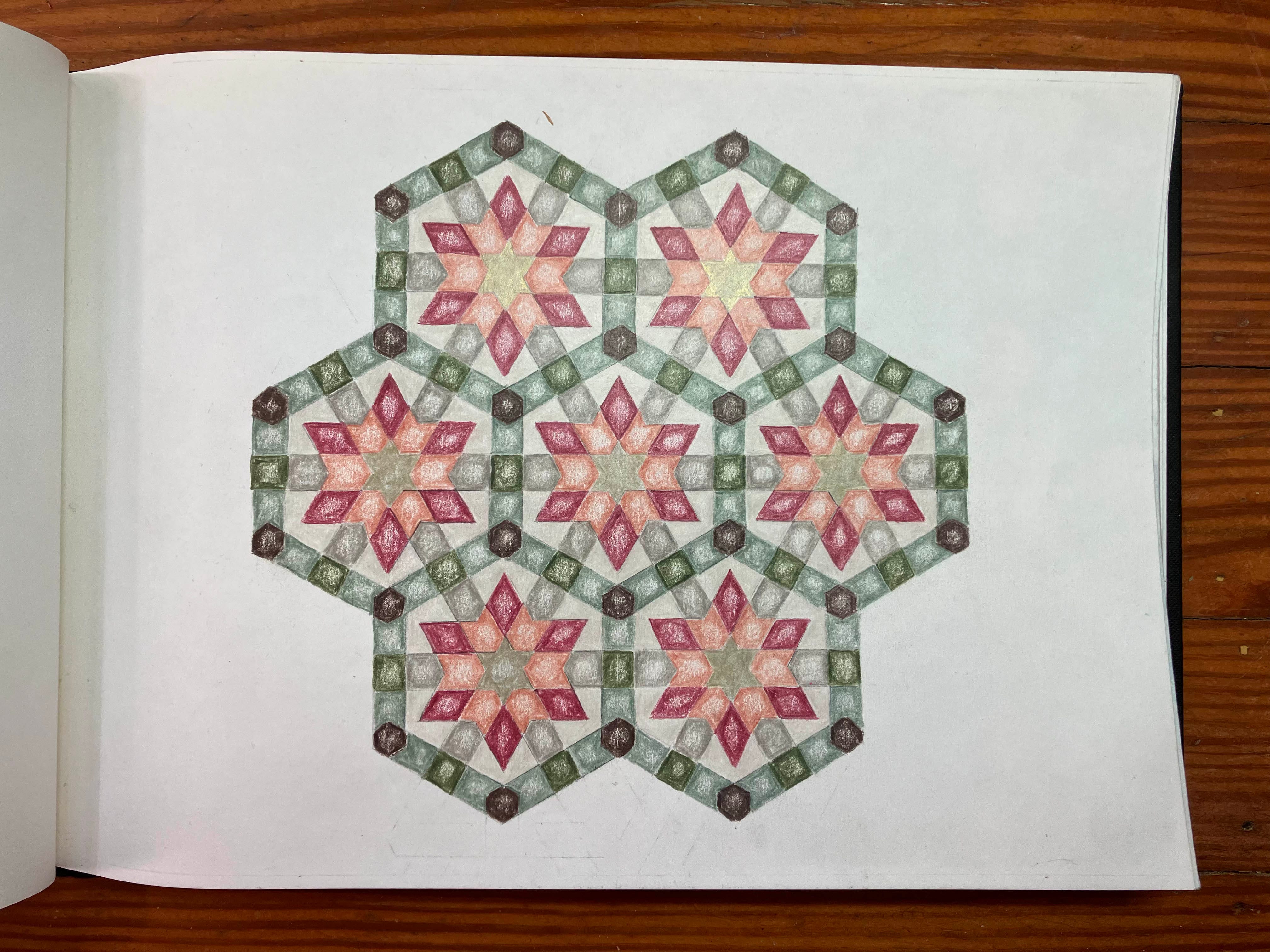
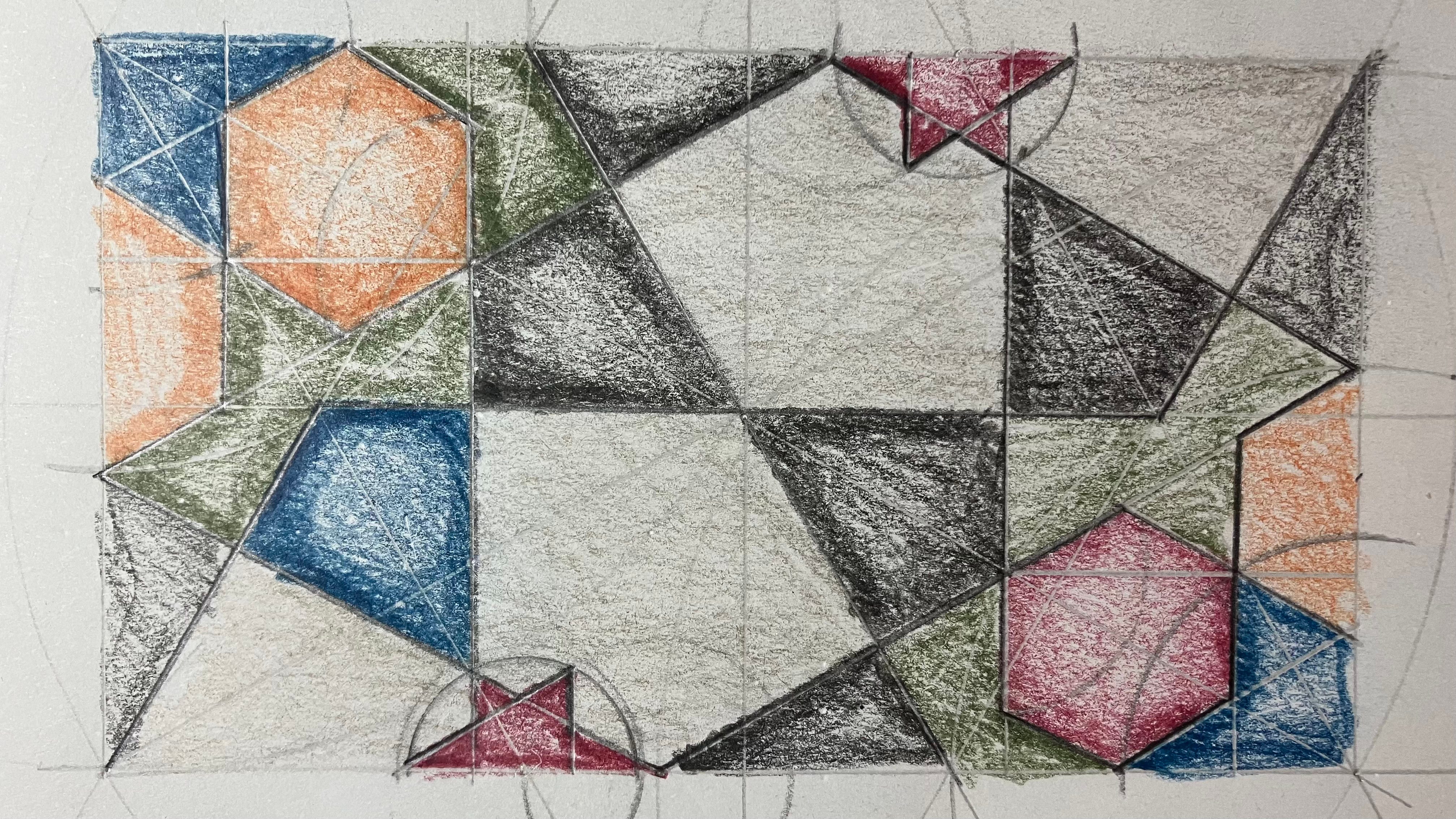
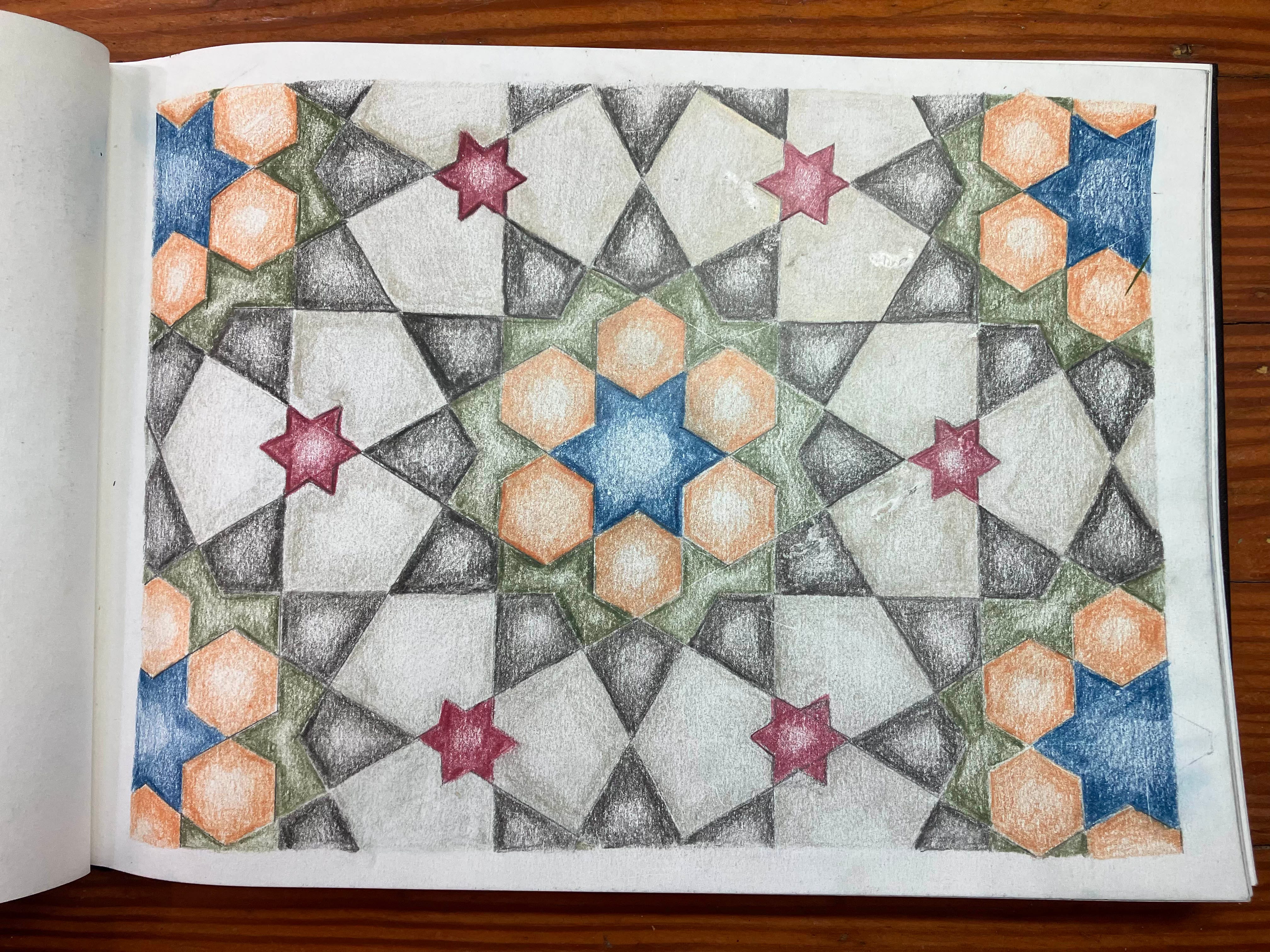
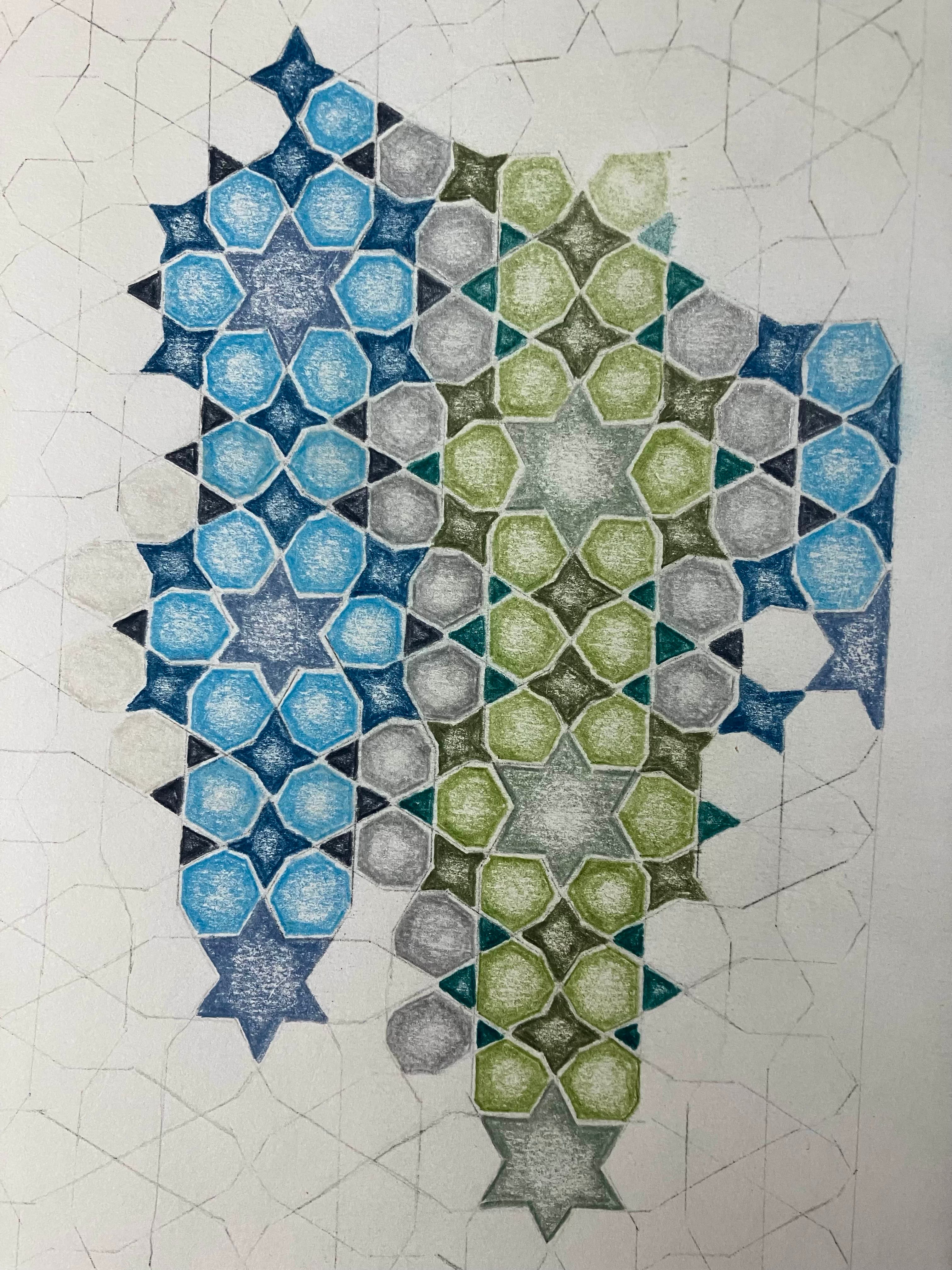
Those six colors made up my first palette of Polychromos pencils, and I raced home to see what I could do with this special shading and gradient technique that I had seen in this single photo of Charlotte Dilley’s — dark and layered on the outside, fading into very light on the inside, giving it a real sense of depth and warmth. Right away, a whole new world of color opened up to me. It was so satisfying… and my girlfriend was so pleased. The photos that I sent her in WhatsApp were no longer gray. They were all kinds of beautiful color — polychromos.
I spent the next couple months with a compass and a straight edge and I followed that up with coloring. And every few days, I’d load up my wheelchair and head over to the All Media store to pick out a few more pencils. The manager got to know me there. I was the guy who showed up in the wheelchair and went straight to the colored pencils. Sometimes I’d spend a half hour picking out my colors.
So, up until that first dreadful crash of 2026, I was coloring. I was coloring, coloring, coloring and I’m gonna show you some samples here in this post. Compared to this eye mask I’ve been wearing for the last couple weeks, it was really a vibrant, colorful time. I’m grateful to be able to share some of it here with you today.
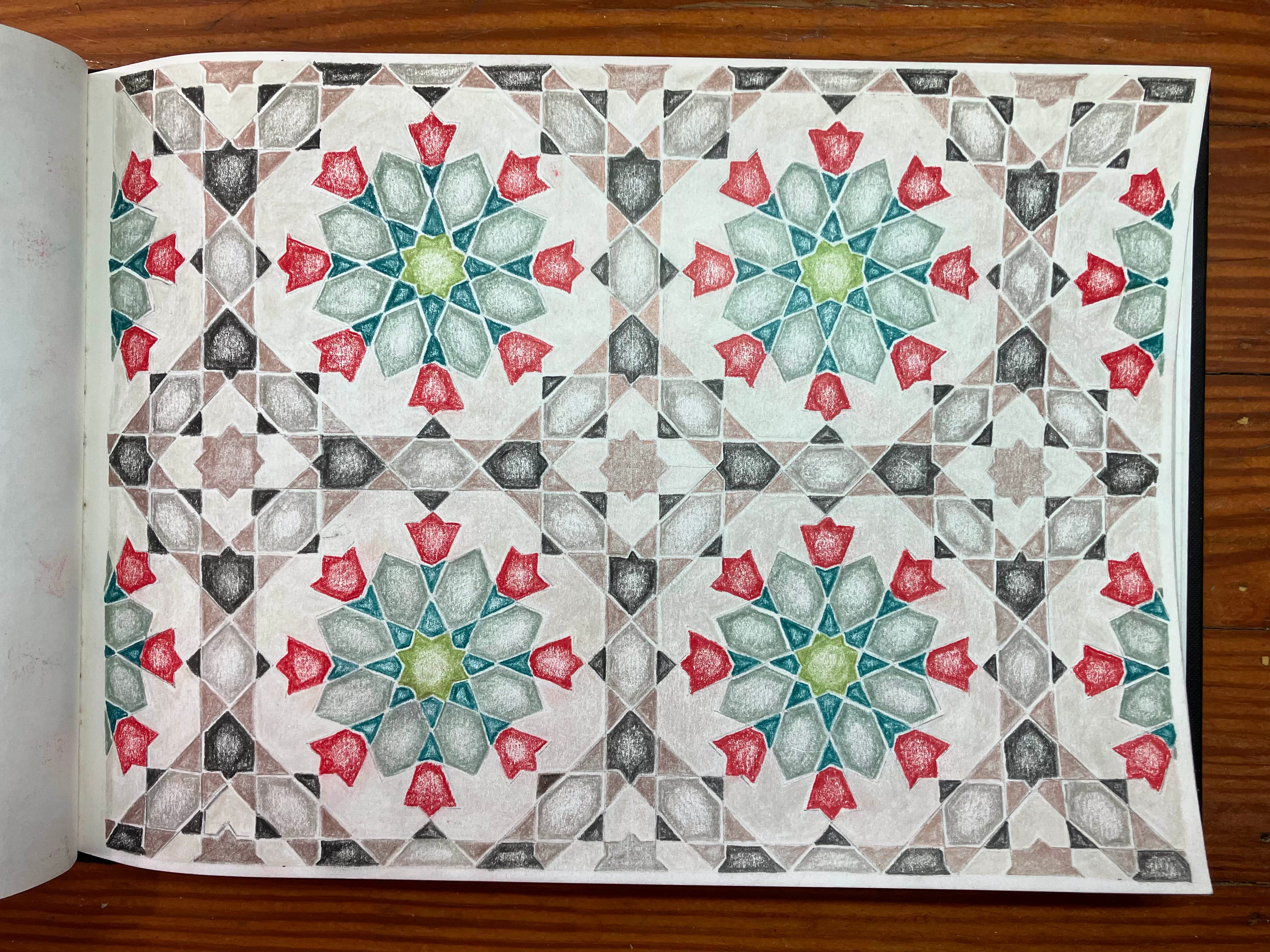
And this is just part one of “Color Theory.” Next time is going to be part two. (And we’ll actually be getting into some of the theory that I’m talking about.) But for now, I just gotta quit. My brain is completely toast — fried. And I’ve just got to stop. That’s one thing that I often don’t know how to do, is to stop when I’m on a roll. So I’m going to stop and we’re gonna make a part two next time.
Thank you so much for being here. I’m looking forward to telling you the rest of the color theory story. It’s very interesting. Thanks so much. I appreciate you sticking around, not losing hope. I know I haven’t posted for a long time. I’m really glad to be here. And I’m still going… still going. It hasn’t been easy. I look forward to seeing you. I look forward to seeing you in the springtime. Maybe we can all circle up and hold hands and sing a song together. That’s what we need.
It’s been quite a time in the world. I’ve been watching it here from my bed and I’m shaking my head a lot. Wish I could be out there doing more. I wish I could be out there doing more service. But here I am learning about color theory. All right, see you next time. Thank you so much.
Oh, by the way, remember, enjoy living in that body of yours today. It’s not gonna be around forever. Take advantage of what you got. Okay, have a good one. I love you. Bye. Bye.